
50+ Voice-Over Industry Terms Every Client and Artist Should Know
October 1, 2026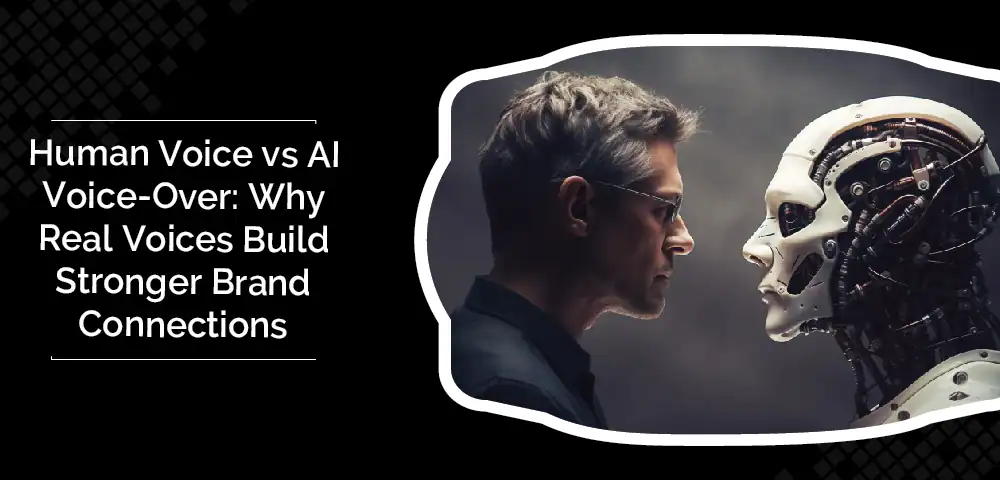
AI-generated voice is everywhere in 2026: fast, scalable, and increasingly convincing. But as synthetic audio becomes the default across more and more production pipelines, something quietly important starts to get lost. When every brand begins to sound the same, the voice stops being an asset and becomes background noise.
This blog discusses what human voice-over delivers that AI cannot and why that gap matters most where trust, emotion, and brand authenticity are on the line. Also, why are the brands that choose real voices making a strategic decision, not just a creative one?
A] Why Brands Are Turning to AI Voice-Over and Where It Makes Sense
The appeal of AI voice-over is genuine and worth acknowledging honestly. It is fast, cost-effective, available around the clock, and requires no studio time or session scheduling. For high-volume functional content, internal notifications, automated messaging, instructional audio, and transactional communication where the primary goal is information delivery, synthetic voice is a practical and often perfectly adequate solution.
The trade-off becomes significant the moment emotional nuance enters the brief. When the content needs to build trust, create a feeling, hold an audience’s attention, or represent a brand to the outside world, the calculation changes.
B] What Human Voices Do That AI Voice-Over Cannot
1. Intent, Not Just Words
A human voice carries intent. A skilled voice-over artist in India reads the brief, understands the audience, and makes hundreds of instinctive decisions about emphasis, pace, and tone before recording a single line. AI processes text. It has no understanding of what the words mean, who is listening, or what that listener needs to feel when the audio ends.
2. The Warmth in a Pause
Some of the most effective moments in a voice-over performance are not words at all. They are the pauses, the breath before a significant line, the slight drop in pace that signals something important is coming, and the energy that rises behind a phrase without the volume changing. These are the micro-details of human delivery that communicate genuine emotion and make an audience trust what they are hearing. They cannot be engineered through a prompt. They come from a performer who understands the material and knows what it needs.
3. The Uncanny Valley of Synthetic Audio
Audiences sense inauthenticity even when they cannot articulate why. There is a quality to AI-generated voice, particularly in emotionally driven content, that registers as slightly wrong without the listener being able to identify the source of their discomfort. It is the audio equivalent of the uncanny valley, close enough to human to pass a surface-level check but missing something fundamental that the listener feels rather than hears. For brand content where subconscious trust is part of what is being built, that subtle friction works quietly against the message.
4. Natural Variation as a Performance Asset
Human voice-over performances have natural variation in pace, emphasis, breath, and energy that makes the delivery feel alive rather than generated. That variation is not inconsistency. It is authenticity, the quality that tells the listener they are hearing a real person who means what they are saying. Emotional marketing works at the level where decisions are actually made, not through information without feeling that moves them toward the brand.
C] Why Emotional Connection Still Wins in Every Content Format
The formats change. The principle does not. In advertising, the right voice is the difference between a performance that makes a campaign resonate and one that gets processed and forgotten. The audience does not remember the information in a well-made ad. They remember how it made them feel, and the voice is one of the primary instruments producing that feeling.
In brand films, corporate films, and video productions, genuine warmth in a performance is what stays with an audience long after the specific details have faded. A voice that feels real creates a connection that a synthetic voice, however technically polished, has not yet been able to replicate consistently.
When you hire a voice-over artist for documentary narration and audiobooks, the voice is the entire experience. There are no visuals to compensate for a flat or unconvincing performance. The narrator carries the audience through the content on the strength of their delivery alone, which is why casting and craft matter so much in these formats.
The common thread across every format is the same. Make the audience feel something. That is where human voices have a lasting and meaningful advantage over synthetic ones.
D] In a World of Synthetic Voices, Authenticity Becomes a Differentiator
As AI-generated voice becomes the norm across more production pipelines, the brands that choose human voice-over are making a statement that goes beyond the audio itself. Investing in a real voice signals something to an audience. It communicates that the brand values genuine connection over convenient production. In a content environment increasingly filled with synthetic audio, that signal is becoming more noticeable, not less.
When voice is treated as part of the brand experience rather than a line item in the production budget, audiences respond differently. They engage more, trust more, and remember more. Authentic voice-over is one of the most direct ways a brand can demonstrate that it takes its audience seriously, and in 2026, as the volume of AI-generated content continues to grow, that authenticity is becoming one of the clearer points of differentiation available to brands that are willing to use it.
The brands that sound human will stand out. Not because human voice-over is a novelty, but because genuine connection, delivered through a real performance, is something an audience can feel, and feeling is what drives the decisions that matter to a brand.
E] How to Decide: When to Use AI Voice and When to Choose Human Voice-Over
The decision comes down to one question: what does the content need to do?
Use AI voice-over when:
- The content is functional and transactional with no emotional brief attached.
- Volume is high, and the audience is not being asked to feel anything specific.
- The format is internal, automated, or instructional, such as notifications, customer service audio, or high-volume training content.
Choose human voice-over when:
- The goal is trust, connection, brand recall, or audience engagement.
- The content represents the brand publicly, and the audience is being asked to feel something.
- The format is advertising, a brand film, a documentary, an audiobook, a corporate film, or any content where emotional connection is part of what makes it work.
For these formats, professional voice-over services built around real performance deliver what synthetic voice currently cannot. The decision is not really about budget. It is about what the content needs to achieve and whether the voice being used can actually achieve it.
Conclusion
AI voice-over has earned a genuine place in modern content production, and it is working well, though. But the formats where trust is being built, where a brand is representing itself to an audience, and where emotion is the mechanism through which the message lands are the formats where human voice-over still has a decisive and meaningful advantage. As synthetic audio becomes more widespread, that advantage becomes more visible, not less. The brands that invest in real voices are not resisting technology. They are understanding what their audience actually responds to and making the right creative decision for the content that matters most.
Peter Abraham has delivered thousands of voice-over projects across India and internationally, from IVR systems and e-learning modules to national television commercials and full-length documentaries, for clients including Amazon, Airtel, BBC, and Lenovo. He is also a Netflix India-certified dubbing artist, having lent his voice to several theatrical releases and OTT shows across popular platforms like Netflix, Prime Video, Crunchyroll, and more. If you have a project in mind and want to know exactly what it will cost, get in touch and get a tailored quote for your specific requirements.
(Please note that all voice-over recordings are conducted remotely in professional-grade studios. This approach ensures top-quality sound and allows talented artists to deliver exceptional performance. Advanced remote recording technology provides seamless communication and studio-quality results regardless of location.)

Peter Abraham
Peter Abraham is a versatile voice-over artist based in Mumbai working in the voiceover industry since 2009. With a passion for storytelling and meticulous attention to detail in every project, he brings scripts to life with his captivating voice and professional delivery, exceeding client expectations. Whether it's a commercial or an audiobook, Peter specializes in a wide range of voice-over work, ensuring the highest quality.