Why Micro Dramas Are Popular in 2026 and How Micro Series Dubbing Is Scaling Them Globally
September 21, 2026
Human Voice vs AI Voice-Over: Why Real Voices Build Stronger Brand Connections
October 15, 2026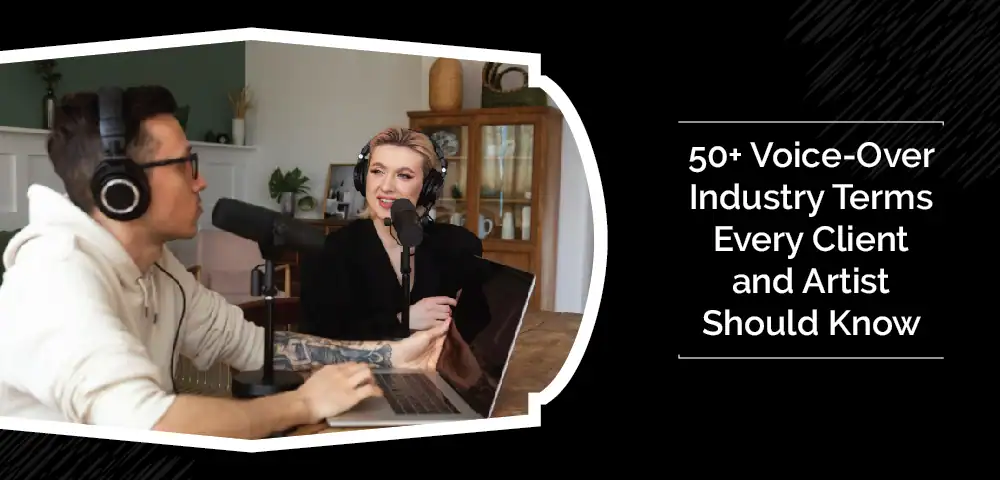
If you ever found yourself in a recording booth shaking your head in agreement with the director’s request, only to realise later on that you didn’t quite understand what they were saying, then this article is for you. If you are a client, producer, or even a beginning voice actor, knowing the lingo will help everything go much faster. This dictionary compiles the most common voice-over terms used in the voice industry.
A] Performance Terms Every Voice Artist and Client Should Understand
Performance terms are most often used during direction and recording and are the ones clients most often mix up.
- ABC Read: Recording the same script three times with three different deliveries, usually straight, warm, and energetic, to give the client options without requiring multiple sessions.
- Cold Read Vs. Dry Read: A cold read is a performance with no preparation, while a dry read refers to audio recorded completely raw without any processing, music, or sound effects (no compression, EQ, or music beds).
- One-Take Vs. Outtake: A one-take recording is a performance done in one continuous take, while an outtake is a recording that does not make the final cut but is saved for future reference.
- Slate: The voice artist says their name, the project name, or the take number at the beginning of the recording to help edit and organise the session during post-production.
- Double: Record the same line two times in a row to give the editor two similar takes to work with.
- Pace Vs. Tempo: Pace is the overall speed of a delivery across the full script. Tempo is the rhythm and variation within individual sentences. A strong voice-over performance manages both independently.
- Pickups Vs. Retakes: A pickup records only a specific section to replace a line or correct an error. A retake means recording the entire script again from the beginning.
- Punch In: Recording over a specific section of an existing take to correct a single word or phrase while keeping the rest of the performance intact.
- Read Length vs. Word Count: Read length is the actual duration of the recorded audio. Word count is the number of words in the script. These do not always correspond because pace and pauses affect how long a script runs in practice.
B] Studio and Technical Terms That Come Up in Every Session
Technical voice-over terms are where clients tend to go quiet and nod along. This section gives both sides a shared vocabulary for the studio environment.
- Hot mic: A microphone that is open and picking up any sound from the booth, meaning everything that is being said with it is being recorded.
- Level: The volume at which the voice artist records.
- Clipping: The distortion that happens when the recorded audio exceeds the highest calibration mark and cannot be fixed during post-production.
- Compression: The process of reducing the volume and dynamic range of a recorded file to make it sound consistent and controlled.
- Normalisation: A process where you make the entire file louder so the top level matches the highest point in it.
- Room Tone: The actual ambient noise of the recording room made when no one is talking, recorded at the beginning or end of each session, and used to fill in spaces between edits.
- Plosive vs. Sibilant: Speech sounds made by forcing air out to form consonants like P, B, etc. A plosive sound is created when the speaker’s breath hits the microphone, causing an unwanted popping sound. Sibilants, on the other hand, are made with the S and SH sounds and are characterised by excess hissing sounds. Both are suppressed using special microphone techniques.
- Pop Filter: A special filter placed between the voice and the microphone that prevents plosives from producing popping sounds.
- Music Bed: Background music layered with voice-over during post-production to create a composite track.
- Back Bed vs. Front Bed: A back bed is designed to fall away beneath the voice-over, while a front bed is heard before the voice-over begins and then falls away as the voice is heard.
- Walla: Background crowd or group sound added in post-production to create ambience in a scene.
- Foley: Recorded sound effects created and added in post-production to enhance the audio of a production, such as footsteps or object handling.
- EFX/SFX: Sound effects that are added to production in post-production. The two terms are often used interchangeably within the industry.
- TTS (Text-to-Speech): Synthetic voice created by computer programs which transform written text into speech, as opposed to professional voice-over, which has human emotion and expression.
- DAW (Digital Audio Workstation): The software used to record, edit and professionally mix audio files, such as Pro Tools, Adobe Audition or Logic Pro.
- Booth / Sound Booth: The room where the voice artist is situated, soundproofed to prevent any external noises from interfering with the recording.
- Talkback Mic: A microphone situated in the control room which allows the director to communicate with the voice artist in the booth without being picked up by the recording microphones.
- Gain: The degree to which the audio signal is amplified before being sent to the recording software.
- Signal Chain: The electrical circuit consisting of all equipment an audio signal passes through from mic to recorder, an important consideration for achieving a professional sound.
- Noise Floor: All background noises that can be heard within a recording.
C] Directing and Script Terms Both Sides Need to Know
Directing voice-over terms are the shorthand that keeps sessions moving. When clients and artists speak the same language here, recording sessions run faster and cleaner.
- Cue Up: The instruction to prepare to begin recording from a specific point in the script.
- Doughnut: A piece of audio with a recorded introduction and conclusion but an open middle section left empty for a localised or customised message to be inserted, common in advertising templates.
- Tag: A short line added at the end of a voice-over, typically a brand name, tagline, or call to action, often recorded separately so it can be swapped across different versions of the same ad.
- Spot: The complete finished voice-over for an advertisement.
- Copy: The written script that the voice artist reads during a session. Copy and script are used interchangeably.
- Read: The act of performing the copy. When a director asks for another read, they want another full performance from the beginning.
- Ad Lib: An unscripted line delivered by the voice artist during a session and sometimes encouraged to use if a scripted line would sound unnatural in delivery.
- Annotated Script: A script marked up with direction notes, emphasis cues, pronunciation guides, and timing markers before the session begins.
- Scratch Track: A rough temporary voice-over recording used during editing or animation as a placeholder before the final professional recording is commissioned.
- Wild Line: A line recorded outside its normal script context, used to give the editor an alternative version of a specific phrase.
D] Business and Contract Terms Every Client Must Know Before Signing
Business terms are where the most expensive misunderstandings happen. A client who confuses a buyout with unlimited rights can end up in a costly dispute.
- Buyout Vs. Flat Fee Vs. Session Fee: A buyout is a single payment covering all usage rights for a specified period. A flat fee covers the recording session only. A session fee is payment for the artist’s studio time, which may or may not include usage rights.
- Usage Rights: The rights to use the recorded voice-over on a particular platform, region, and period reserved exclusively for the client. Usually, it is negotiated separately from the recording fee.
- Exclusivity: An option that prohibits the voice artist from recording similar projects for competitors for a certain period and is paid additionally.
- Talent Fee: The fee paid to a voice artist for the recording service, excluding the studio recording and mastering costs.
- Residuals: Ongoing payments made each time a recording is broadcast beyond the originally agreed terms, more common in union and broadcast advertising contexts.
- Per Project vs. Retainer: ‘Per project’ means the artist is engaged and paid for each project. A retainer means the client pays an agreed fee to retain the artist’s availability over a defined period.
- Broadcast Rights Vs. Digital Rights: Broadcast rights cover television and radio use. Digital rights cover online platforms, including social media and streaming. These are priced and negotiated separately in most professional voice-over service agreements.
- Union Vs. Non-Union Talent: Union talent works under agreements governing minimum fees and working conditions. Non-union talent negotiates terms independently.
- Turnaround Time: The agreed time between the client delivering the final script and the artist delivering the completed recording.
- Revision Policy: The terms under which a client can request changes to a completed recording, typically a defined number of revisions within the project fee.
E] Dubbing and Localisation Terms for Global Content Projects
As an increasing amount of content is crossing borders, dubbing and localisation terms are no longer niche knowledge. They are vital vocabulary for any creator or brand working with international audiences.
- ADR (Automated Dialogue Replacement): Re-recording of a character’s line in a studio, separately from the main shoot, which is then synced to match the existing footage, and may be used either to replace on-set recordings or as the source of the final dubbed track.
- Lip-Sync Dubbing: Dubbing that is timed to match the on-screen character’s visible movements of their mouth, requiring the dubbed line to have similar consonants and vowels as the performance in the original language.
- Voice Matching: Replicating the tone, emotion, pace, and character essence of an original actor’s performance in a new language. As any voice-over artist for a documentary dubbing project demonstrates, voice matching is about emotional equivalence, not acoustic imitation.
- Voice Cloning: The application of AI to imitate specific attributes of a voice for utilisation in new recordings presents ethical and legal implications relating to consent and intellectual property.
- Localisation vs. Translation: Translation changes text from one language to another. Localisation modifies an entire piece of content, making it seem as if it was created in its target market rather than just being translated.
- Subtitling Vs. Dubbing: Subtitling involves the addition of texts that are translations of dialogue, which are projected on the bottom of a display as the characters speak. Dubbing, on the other hand, replaces the voices of characters with those speaking in the target language.
- Mouth Flap: A mouth flap occurs when characters’ mouths move in a dubbed version when there is no accompanying soundtrack. It is regarded as a serious error in the field of professional dubbing.
- Loop Group: A loop group is a team of voice artists who are employed to record background comments or conversations for the production of a movie or television show.
- Post-Sync: Recording audio after the visual element of a production has been completed and edited, synchronising the new audio to the existing footage.
- Language Track: A complete audio recording of a production in a specific language, mixed and ready for playback as part of a multilingual global content release.
Conclusion
Knowing the language of voice-over does not make you a voice artist or a sound engineer. However, it makes every brief cleaner, every session faster and every contract clearer. Whether you are a client walking into the studio for the first time or a voice-over artist in India learning the jargon, these are the terms that pop up in every project. The more fluently both sides know and use them, the better the work that comes out of the session.
Peter Abraham has delivered thousands of voice-over projects across India and internationally, from IVR systems and e-learning modules to national television commercials and full-length documentaries, for clients including Amazon, Airtel, BBC, and Lenovo. He is also a Netflix India-certified dubbing artist, having lent his voice to several theatrical releases and OTT shows across popular platforms like Netflix, Prime Video, Crunchyroll and more. If you have a project in mind and want to know exactly what it will cost, get in touch and get a tailored quote for your specific requirements.
(Please note that all voice-over recordings are conducted remotely in professional-grade studios. This approach ensures top-quality sound and allows talented artists to deliver exceptional performance. Advanced remote recording technology provides seamless communication and studio-quality results regardless of location.)

Peter Abraham
Peter Abraham is a versatile voice-over artist based in Mumbai working in the voiceover industry since 2009. With a passion for storytelling and meticulous attention to detail in every project, he brings scripts to life with his captivating voice and professional delivery, exceeding client expectations. Whether it's a commercial or an audiobook, Peter specializes in a wide range of voice-over work, ensuring the highest quality.