Human Voice vs AI Voice-Over: Why Real Voices Build Stronger Brand Connections
October 15, 2026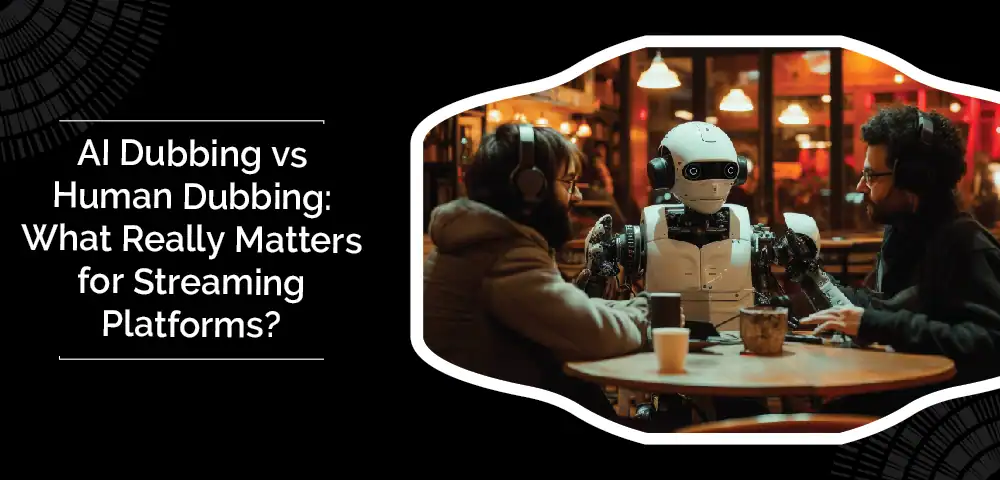
Streaming platforms are reaching audiences in more languages and regions than ever, and demand for localised content has never been higher. AI-generated audio has changed what is possible at scale, making it faster and cheaper to produce multiple-language versions of the same content. At the same time, human dubbing remains the established approach that the industry has built its quality standards around. The choices between the two involve more than speed or cost. Performance quality, cultural adaptation, character consistency, lip-sync accuracy, and platform delivery requirements are all factors that come into play. This blog looks at where each approach fits and what streaming producers should be considering when it comes to choosing a dubbing workflow.
A] Understanding AI Dubbing and Human Dubbing
AI dubbing utilises synthetic voices, automating translation, voice cloning, and automated timing or lip-sync technology to localise the audio without requiring voice actors in a recording booth. The process can move quickly and scale across multiple languages simultaneously.
Human dubbing is the established production approach involving translation, script adaptation, voice casting, dubbing direction, studio recording, editing, mixing, and quality control at every stage. Each element of the process is managed by people with specific expertise in their area of the workflow.
Both approaches aim to create localised content that feels natural and engaging to the target audience. Where they differ is in how they get there, the tools and talent involved, and how effectively they handle the more complex creative and cultural demands of the content being localised.
B] AI Dubbing vs Human Dubbing Across Key Factors
For streaming producers evaluating their options, the differences across key production factors are worth understanding clearly before committing to a workflow.
| Factor | AI Dubbing | Human Dubbing |
| Turnaround | Faster, particularly for high volumes | Requires more production time per language |
| Scalability | Can support large content libraries and multiple languages simultaneously | Requires dedicated workflows and casting per language |
| Voice performance | Synthetic and increasingly expressive | Actor-led performance with full interpretive range |
| Emotional delivery | Depends on the technology and translation quality | Interpreted and shaped by the voice actor and director |
| Cultural adaptation | Depends on translation quality and human review | Human-led adaptation at the scripting and performance stage |
| Character consistency | Highly repeatable across episodes | Managed through casting, direction, and session notes |
| Lip-sync | Can be automated with varying accuracy | Professionally directed, edited, and reviewed |
| Quality control | Human review remains an important step | Built into the production workflow at every stage |
The practical advantages of AI dubbing are most significant where volume and speed are the primary drivers. The areas where human dubbing holds a clear advantage are those where creative judgement, cultural interpretation, and performance quality directly affect how the audience receives the content.
C] Where Can AI Dubbing Support Streaming Content?
AI dubbing has practical applications in streaming workflows that are worth understanding clearly.
For platforms that are looking to manage large content libraries across multiple languages, AI dubbing gives a way to rapidly produce localised variations at a scale and speed that might be difficult to achieve with traditional production timelines. Content that requires consistent output of voices across a high volume of episodes, such as tutorials, factual content, or archive material which is being localised for the first time, can see benefits from the repeatability and efficiency of generated audio.
AI dubbing also has a role in early-stage localisation and market testing, allowing platforms to assess audience response in a new language market before committing to a full human dubbing production. For content where emotional nuance and character performance are not the primary drivers, such as instructional series or voice-over for explainer video content, AI tools can deliver a functional result efficiently.
The important qualifier in all of these applications is that human review remains a necessary step. AI-generated audio requires oversight to catch translation errors, unnatural phrasing, cultural missteps, and timing issues that automated processes do not always identify reliably.
D] Why Human Performance Matters in Streaming Dubbing?
For scripted drama, comedy, animation, and any content where the audience’s emotional engagement is central to the viewing experience, human dubbing brings qualities to the production that AI tools have not yet consistently replicated.
1. Emotional Interpretation
Voice actors respond to the emotional content of a scene in ways that go beyond the words on the page. They read the tension, the humour, the grief, or the excitement of a moment and shape their delivery accordingly. That interpretive layer is what makes a dubbed performance feel like it belongs to the character rather than sitting over them. For professional voice-over services at a streaming level, that emotional range is a production requirement, not a creative luxury.
2. Character Identity
A character’s voice carries their personality, age, attitude, energy, and relationship to the other character on screen. Professional voice casting matches these qualities in the target language, creating a dubbed performance that preserves the character’s identity across the full run of a series. Maintaining that identity requires human judgement at the casting stage and consistent performance direction throughout production.
3. Cultural Adaptation
Humour, idioms, cultural references, and social context do not translate word for word. A line that lands naturally in the source language may be meaningless, confusing, or unintentionally offensive in the target market if it is not adapted by someone who understands both cultures. Human-led adaptation at the scripting stage is what allows dubbed content to feel native to its audience rather than foreign. This is one of the areas where the gap between AI-assisted translation and professional human adaptation is most consequential for streaming content.
4. Performance Direction
Dubbing directors work with voice actors during recording sessions to adjust delivery based on the scene, the on-screen performance, and the overall creative tone of the production. That real-time guidance produces performances that serve the content in ways that automated processes cannot replicate. Productions are expected to maintain creative intent, authentic voice-over acting, and contextual understanding throughout the dubbing process, all of which depend on skilled human involvement at the direction and performance stage.
5. Consistency Across a Series
Maintaining character voice, performance choices, and tonal consistency across multiple episodes requires casting records, session notes, and experienced direction. For long-running streaming content, that consistency helps the dubbed version feel like a coherent creative work rather than a collection of individually localised episodes.
For streaming content that demands this level of performance and consistency, partnering with an experienced voice-over artist in India like Peter Abraham is the most reliable way to achieve it.
E] What Streaming Platforms Expect From Localised Content
Platform requirements for localised content focus on the quality of the final output rather than the production method used to create it. Most platforms expect:
- Accurate and natural dialogue that reads as native to the target language
- Cultural and contextual accuracy that reflects genuine understanding of the audience
- Appropriate voice casting that matches the character’s identity and energy
- Authentic performance maintained consistently across the full run of the content
- Lip-sync accuracy where required by the format
- Clean recording and mixing that meets technical delivery specifications
- Consistent quality across episodes with proper quality control before delivery
The production method matters because it directly affects how reliably these standards can be achieved. Producers should verify the current localisation requirements for their specific platform and project before committing to a workflow, as platform standards continue to evolve.
F] Choosing the Right Dubbing Workflow for a Streaming Project
Rather than choosing between AI and human dubbing as fixed categories, the more useful frame is to ask what the specific project requires. Key questions to work through before committing to an approach: How central is character performance to the audience’s experience? How much cultural adaptation is needed beyond translation? Does the content depend on humour, emotion, or dialogue to work? What are the platform’s current delivery requirements? And which stages could be supported by AI tools without compromising the final output?
The appropriate workflow will sit somewhere between fully human-led and AI-assisted with human oversight, depending on the content, the audience, and what the platform expects from the localised version. If you are working as a voice-over artist for an advertising project or any other streaming production, understanding where your content sits on that spectrum is the most useful starting point.
Conclusion
The choice between AI dubbing and human dubbing for streaming platforms is not a single decision but a series of production choices that depend on the content type, the target audience, the languages required, and the platform’s expectations. AI dubbing offers genuine advantages in speed and scalability for the right applications. Human dubbing delivers the performance quality, cultural depth, and character consistency that scripted streaming content depends on. For producers building a localisation workflow, the most reliable approach is to understand what each method does well, identify where the project’s requirements sit, and design a process that consistently meets the quality standards the platform and the audience expect.
Peter Abraham has delivered thousands of voice-over projects across India and internationally, from IVR systems and e-learning modules to national television commercials and full-length documentaries, for clients including Amazon, Airtel, BBC, and Lenovo. He is also a Netflix India certified dubbing artist, having lent his voice to several theatrical releases and OTT shows across popular platforms like Netflix, Prime Video, Crunchyroll and more. If you have a project in mind and want to know exactly what it will cost, get in touch and get a tailored quote for your specific requirements.
(Please note that all voice-over recordings are conducted remotely in professional-grade studios. This approach ensures top-quality sound and allows talented artists to deliver exceptional performance. Advanced remote recording technology provides seamless communication and studio-quality results regardless of location.)

Peter Abraham
Peter Abraham is a versatile voice-over artist based in Mumbai working in the voiceover industry since 2009. With a passion for storytelling and meticulous attention to detail in every project, he brings scripts to life with his captivating voice and professional delivery, exceeding client expectations. Whether it's a commercial or an audiobook, Peter specializes in a wide range of voice-over work, ensuring the highest quality.