Dubbing Voice Actor Techniques: How to Match Tone, Emotion & Pace
September 8, 2026
50+ Voice-Over Industry Terms Every Client and Artist Should Know
October 1, 2026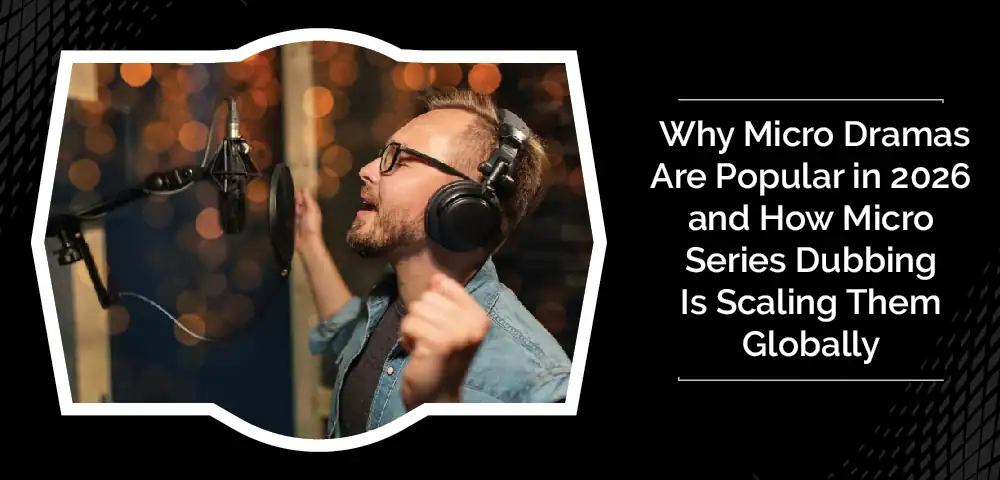
If you have not watched a micro drama yet, chances are someone in your target audience has, probably several in the last hour. Under 90 seconds per episode, cliffhanger-driven, scroll-native, and designed to make the next episode feel non-optional. The format is the fastest-growing in entertainment in 2026, and the stories are emotionally universal enough to travel anywhere. The problem is that most of them are still locked inside one language. That is the gap professional micro series dubbing fills, and this blog explains exactly how.
A] What Is Micro Drama and Why Is It Dominating OTT in 2026?
Micro drama is a short-form episodic video, typically under 90 seconds per episode, built around a single emotional beat or plot development that ends on a cliffhanger. The format is scroll-native by design, fitting naturally into the way the 18 to 34 demographic already consumes content on their phones. Each episode asks for less than two minutes of commitment while delivering enough of a hook to make the next one feel non-optional.
OTT platforms in India, including JioHotstar, Zee5, MX Player, and ShareChat, have already built dedicated OTT micro drama verticals in response to audience demand. What makes the format work is not just its brevity but its emotional immediacy. There is no slow build, no patience for setup, no room for anything that does not immediately matter. Every second either earns the viewer’s attention or loses it, which is what makes micro drama one of the most demanding content formats to produce well and one of the most rewarding to get right.
B] The Micro Series Trend 2026: Numbers That Tell the Story
The China market is where the scale of this shift becomes most visible. Growing from approximately $500 million in 2021 to $7 billion in 2024, micro drama in China did not grow. It overtook the domestic theatrical box office in the same period. Globally, the market was valued at approximately $1.4 billion in 2024 and is forecast to reach $10 billion by 2030.
India’s trajectory tells a similar story. 250 million cumulative downloads by November 2025, representing 16 times year-on-year growth, is not the kind of number that gets explained away as a passing trend. The micro series trends in 2026 are already established. The platforms, the investment, and the audience behaviour are all pointing in the same direction.
The format’s appeal is straightforward. It is mobile-first, emotionally immediate, and structured so that each episode feels like a natural entry point rather than a commitment. Audiences do not schedule time for micro dramas. They find it in the gaps, and they stay.
C] Why Does Micro Drama Dubbing Demand a Different Level of Craft?
Standard dubbing is demanding work. Micro drama dubbing is something else entirely, and the difference comes from the format itself.
1. The Emotional Compression of 90 Seconds
In a feature film or a long-form series, a scene has room to build. A character can take a breath, a pause can land, and the emotional moment has content around it. In a 90-second micro drama episode, every line is doing the work that a full scene would do in another format. There is no room for a flat delivery, a misread tone, or a performance that is technically correct but emotionally off. The margin for error is essentially zero, which means the standard required from a micro drama voice-over performance is significantly higher than standard dubbing work.
2. Volume Without Losing Consistency
A micro drama series does not run to six episodes. It runs to 60, sometimes more. Each episode needs to be dubbed with the same emotional precision as the first, which means maintaining character voice consistency, tonal range, and performance energy across a volume of content that would challenge any production workflow. A character who sounds urgent and emotionally present in episode one needs to sound the same in episode 47. That consistency is a craft challenge as much as a logistical one.
3. Multi-Speaker Accuracy at Scale
Micro drama scenes are fast-paced and dialogue-heavy relative to their runtime. Identifying who speaks, when, with what emotional register, and how that maps to the dubbed performance across multiple characters and dozens of episodes requires a level of precision that goes well beyond standard dubbing. A mistake in character attribution or a misread emotional cue does not just affect one scene. It affects how the audience receives every scene that character appears in afterwards.
4. Cultural Adaptation, Not Word-for-Word Translation
Micro drama dialogue is written to land immediately. It is punchy, idiomatic, and emotionally loaded in ways that do not survive word-for-word translation. Professional micro series dubbing requires cultural adaptation at the scripting stage, rewriting dialogue that is in the original. That is a creative process, not a technical one, and it is what separates dubbed micro series that feel native from those that feel like translations.
D] How to Dub a Micro Drama Series: The Professional Workflow?
Step 1: Transcription and Cultural Adaptation
The process begins with transcription and translation, with cultural adaptation built in from the start. Dialogue is rewritten to land naturally in the target language, accounting for cultural references, idioms, and the rhythm of speech that makes the delivery feel native rather than translated.
Step 2: Voice Casting and Character Matching
Casting for micro series dubbing goes beyond finding a voice in the right language. Each character needs a dubbed voice that carries the same emotional register and personality across the full arc of the series. This decision shapes how the audience connects with every character from the first episode to the last.
Step 3: Recording with Emotional Precision
Recording sessions require artists who can deliver performances timed to the original pacing of each episode, hitting emotional beats accurately within a 90-second window where every second matters. The performance standard required here is consistently high across the full volume of the series.
Step 4: Lip-Sync and Audio Layering
Lip-sync alignment and audio layering are applied to create a final dubbed video that feels completely native. The goal is dialogue that appears to belong to the original performance rather than sitting over it.
Step 5: Quality Review and Delivery
Quality review at every checkpoint covers character consistency, audio quality, sync accuracy, and cultural fit across every episode before delivery. For a series running to 60 or more episodes, this stage is what ensures the final product holds up as a coherent, consistent viewing experience in the target market.
E] What to Look for in Professional Dubbing Services for Micro Series
1. Speed and Precision Together
Micro drama production timelines are tight. A professional dubbing service handles high volumes of short-form content efficiently without letting speed compromise the emotional precision the format demands. These are not competing priorities. Both are non-negotiable.
2. Cultural Fit Per Market
Dubbing a micro series for a Brazilian audience, a German audience, and a Japanese audience are three different creative engagements even when the source content is identical. Cultural fit, the naturalness of the adapted dialogue and the appropriateness of the delivery style for that specific market, determines whether the dubbed series feels like it was made for that audience or merely translated for them.
3. Why Automated Tools Cannot Do This Work
AI voice generation and automated dubbing tools can synchronise audio to video. What they cannot do is make the instinctive creative decisions about emphasis, pace, emotional register, and cultural nuance that a skilled voice-over artist in India brings to every line of a performance. In a format where emotional immediacy is the entire value proposition, professional dubbing services for micro series are not the premium option. They are the only option that actually delivers what the content needs.
Conclusion
Micro drama has already reshaped how short-form content is produced and consumed globally, and the trajectory points clearly toward continued growth. The stories travel. The emotional ingredients that make the format work are universal. What has kept most micro series dubbing is the most effective solution to that problem. For producers and platforms serious about taking regional content to a global audience, the question is not whether to dub. It is how well the dubbing is done.
Peter Abraham has delivered thousands of voice-over and dubbing projects across India and internationally, covering everything from OTT content and theatrical releases to national television commercials and corporate films, for clients including Amazon, Airtel, BBC, and Lenovo. A Netflix India-certified dubbing artist, Peter has lent his voice to productions across Netflix, Prime Video, Crunchyroll, and more. If you have a micro series or dubbing project in mind, get in touch and get a tailored quote for your specific requirements.
(Please note that all voice-over recordings are conducted remotely in professional-grade studios. This approach ensures top-quality sound and allows talented artists to deliver exceptional performance. Advanced remote recording technology provides seamless communication and studio-quality results regardless of location.)

Peter Abraham
Peter Abraham is a versatile voice-over artist based in Mumbai working in the voiceover industry since 2009. With a passion for storytelling and meticulous attention to detail in every project, he brings scripts to life with his captivating voice and professional delivery, exceeding client expectations. Whether it's a commercial or an audiobook, Peter specializes in a wide range of voice-over work, ensuring the highest quality.