Listeners:
Top listeners:
-
 play_arrow
Peter A Voiceovers - StartUp India (explainer) sitemanager
-
 play_arrow
Peter A Voiceovers - Chanakya (audiobook) sitemanager
-
 play_arrow
Peter A Voiceovers - LG - Mute The Growl sitemanager
-
 play_arrow
Showreel (English) sitemanager
-
play_arrow
Showreel (Hindi) sitemanager
-
play_arrow
LG - Mute the Growl sitemanager

Voice Over vs Dubbing: Understanding the Real Difference in Audiovisual Content
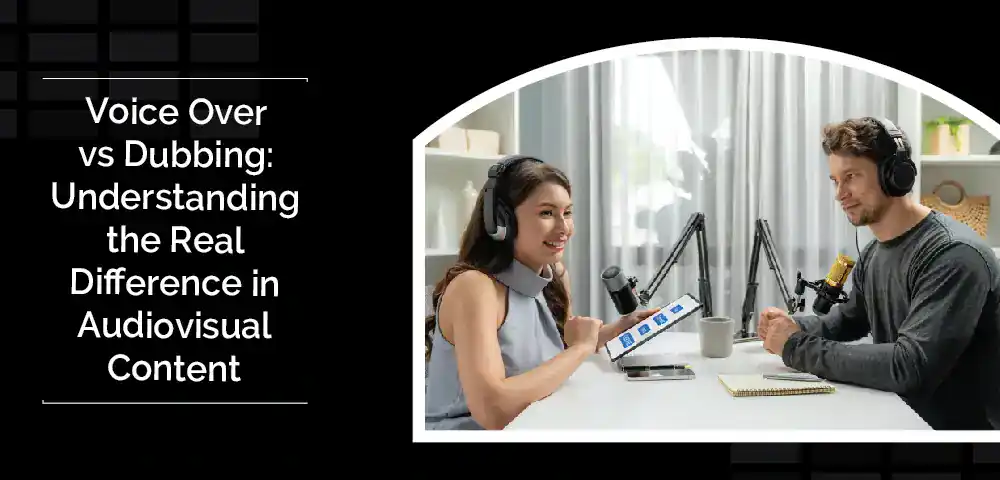
Ever watched a film or ad and wondered whether you were hearing the actor’s real voice or a seamless transition of it? Behind every powerful piece of audiovisual content lies a subtle art: the intersection of sound and emotions. In this world of global media, voice‑over vs dubbing stand as two creative methods that give visuals their soul, yet they’re often mistaken for one another. Both serve a purpose, but in vastly different ways. Whether you are a filmmaker, brand, or content creator working with a voice-over artist in India, understanding this distinction helps your message sound exactly as intended every single time.
A] What Is a Voice-Over?
So, what is the meaning of voice‑over? It is an audio production technique where an external voice narrates, explains, or comments on visuals. The speaker’s face doesn’t appear on screen, and their voice often guides the audience through information. Sometimes, the original audio remains faintly audible below the narration (as in UN‑style presentations), while in other cases, it’s fully replaced for off‑camera delivery.
Voice‑overs focus on clarity, tone, and precision rather than emotional performance matching. They shine wherever information is key, such as:
- Documentaries and Educational Videos
- Business presentations and training packages
- Content for education and e-learning
- Commercials and promotional ads
The presence of a good voice-over artist in the Indian market ensures fluent voices that enable brands, lecturers, or organisations to reach their audience effectively.
B] What is Dubbing in Film & Media?
Dubbing is the replacement of the original spoken dialogue with a translated or newly recorded voice-over that perfectly matches lip movements, tone, and intention from the actors on screen. This technique demands skilled lip‑sync dubbing, emotional authenticity, and impeccable timing.
The process of dubbing tries to reproduce all the minute nuances of the original, whether it is a whisper or a chuckle, and translate it into the target language. This, unlike plain narration, not only requires the general translation but also focuses on the minute details, and its common uses are:
- Feature Films & OTT Content
- TV Series, TV Dramas
- Animation and gaming
- Children’s programming, which needs to be fully localised
Precision, emotion, and address to the target audience, delivered perfectly in dubbing, allow audience members to almost feel as if it is their media. It’s both an art and a technical craft blending language, performance, and cultural understanding.
C] Voice-Over vs Dubbing: Key Differences Explained
Lip Sync & Performance
Voice-over does not require matching lip movements; it delivers narration independent of the character on screen. The performer prioritises pace, tone, and comprehension. In contrast, dubbing demands tight synchronisation to lip movement and emotions, ensuring dialogue appears as if spoken by on-screen actors themselves. Lip‑sync dubbing significantly enhances immersion in film and OTT viewing.
Audience Experience
A voice-over feels informational and objective; it tells or explains. Dubbing can feel natural and emotional; it helps the viewer believe in the performance. In storytelling, like movies or web series, audiences stay connected to the character’s feelings rather than the original voice.
Cultural Adaptation
Voice-over retains the original speech, accent, and even sound to maintain the realism of the performances. On the other hand, dubbing alters the content much more significantly, as idioms, jokes, and local sayings are changed for a new culture. Thus, dubbing bridges linguistic divides and strengthens emotional relatability across borders.
Cost & Production Time
When comparing voice‑over vs. dubbing cost, voice‑overs are generally more economical and faster. They use fewer artists and minimal editing. Dubbing, however, requires multiple performers, translators, linguists, and engineers to ensure script‑sync precision; therefore, it’s more time‑intensive and costly.
Content Loyalty
Voice‑overs remain loyal to the authenticity of the source material. The original emotion stays, even when narration overlays it. Dubbing, on the other hand, re‑interprets the dialogue for better audience comfort in the target language. These methods have different goals: communication of a storytelling message versus immersion in a culture.
D] Voice Over vs Dubbing – Pros and Cons
Voice-Over – Pros
- Low prices and fast delivery.
- Perfect for business, educational, or explanatory projects
- Clear delivery and consistent mood.
- Maintains original audio authenticity.
- Quick scalability for multiple languages.
Voice‑Over – Cons
- Less immersive for entertainment.
- Lack of emotional complexity.
- This could divert attention from the initial performances.
- Inappropriate for stories that prioritise character growth.
Dubbing – Pros
- Facilitates a stronger emotional bond and boosts audience involvement.
- Fluent, tailored experience across different languages.
- Favoured for films and OTT material
- Perfect lip-sync creates a natural viewing.
- Full cultural adaptation, including idioms.
Dubbing – Cons
- Higher cost and longer production process.
- Requires expert voice actors and precise synchronisation.
- Complex coordination of multiple talents.
- Risk of losing original vocal nuance.
Choosing between both depends on the project’s language goals, messaging style, and target medium.
E] When to Use Dubbing or Voice-Over
Voiceover is most effective if you’re doing an educational video, documentary, or internal communications video, where it’s essential to have clear, authoritative, and budget-friendly content. It’s also ideal to use while creating online courses and product videos to maintain the authenticity and ambience related to the audio present in your content, such as narrations and dialogues.
Dubbing is always in high demand regarding movies, OTT series, animation, and dramatic productions in which emotionally significant storytelling is important. Dubbing is a process of recreating a performance, allowing viewers to experience a performance without reading any subtitles. When it is a matter of multilingual distribution or regional releases of any entertaining content, it is important to decide between dubbing vs voice-over. Both approaches complement creative intent; one strengthens comprehension, while the other amplifies connection.
F] Making the Right Choice for Your Project
Every production requires a unique sound strategy. You should consider:
- Target Audience: Who will listen? Are they multilingual?
- Purpose: informative narration or dramatic storytelling?
- Platform: OTT series, brand films, e-learning, or internal videos?
- Budget and timeline: how quickly must it deliver?
There is no one better way, but just the right way for you and your message. Voiceovers and dubbing do not compete with one another. Instead, they complement and influence one another. With the guidance of a seasoned veteran such as Peter Abraham, you will be able to lend your message a voice that speaks to the world.
Conclusion
To use the correct audio with the correct message, it is important to understand the difference between a voice-over vs dub-over. Dubbing is when the emotion is introduced back into the narrative so that the viewer can experience it, while a voice-over service in India gives the viewer the message clearly and accurately. Both of these elements in audiovisual narratives have been essential in the creation of visuals as messages that can communicate beyond language.
Peter Abraham, a leading voice-over artist in India, specialises in both voice-over and dubbing for filmmakers, brands, and content creators. With experience across corporate videos, films, and OTT projects, he delivers audio solutions matching your needs, clear narration, or precise lip-sync dubbing. Ready to choose between voice-over vs. dubbing for your production? Contact Peter Abraham to discuss custom voice solutions that make your content resonate globally.
FAQs
What is the fundamental difference between voice‑over and dubbing?
The core difference between voice‑over and dubbing is that voice‑over adds narration over existing audio, while dubbing fully replaces the original dialogue with a new performance in another language, often using lip sync dubbing for natural results.
When should I choose dubbing over voice‑over for a project?
Choose dubbing vs voiceover when emotional storytelling and character immersion are crucial, such as in films, OTT series, and animation, especially if you want audiences to enjoy content in their own language without reading subtitles.
How does lip‑syncing in dubbing work compared to standard voice‑over narration?
In dubbing, lip sync dubbing carefully matches the timing, mouth shapes, and emotional beats of the on‑screen actor, whereas standard voice‑over narration focuses on clear delivery and pacing without needing exact visual synchronisation.
Which technique is generally more time‑consuming and expensive: voice‑over or dubbing?
When comparing voice-over vs dubbing cost, dubbing is usually more expensive and time‑consuming because it involves adapted scripts, multiple actors, and precise syncing, while voice‑over is faster and leaner in production resources.
Can a single voice actor perform both voice‑over and dubbing roles?
Yes. Many professionals in voice-over service in India handle both, switching between clear, informative narration for voice‑over and emotionally rich, character‑driven performances for dubbing across films, ads, and branded content.

Peter Abraham
Peter Abraham is a versatile voice-over artist based in Mumbai working in the voiceover industry since 2009. With a passion for storytelling and meticulous attention to detail in every project, he brings scripts to life with his captivating voice and professional delivery, exceeding client expectations. Whether it's a commercial or an audiobook, Peter specializes in a wide range of voice-over work, ensuring the highest quality.





Be the first to leave a comment