
How Can Small Businesses Sound Big with Voice-Overs?
December 6, 2025
How the Voice-Over Industry Changed in 2025: A Year-End Review
December 31, 2025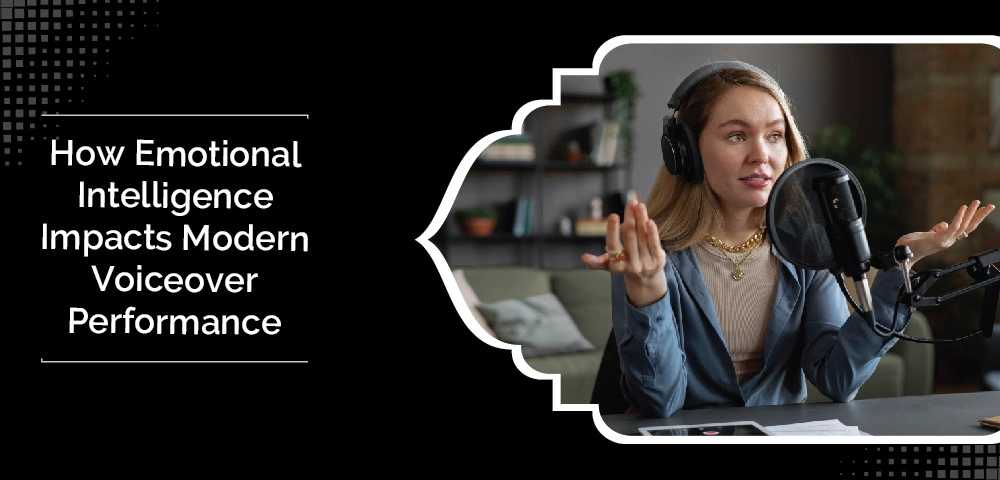
Have you ever noticed how great voice-over actors don’t just read lines; they convey feelings? That’s where the emotional intelligence in voice-over comes in. Emotional intelligence (EI) is the ability to recognise your feelings, understand, and manage your emotions. During voice-over performances, EI enables performers to bring the script to life with the right tone, pace, and expression. When a voice-over actor really feels the joy of a character, the microphone picks up more than just words; it picks up real energy and emotion.
This blog looks at how emotional intelligence in voice acting shapes and defines modern voice-over performance and why the trait is indispensable to success.
Contents
A] Understanding Emotional Intelligence
It is more than just the recognition of feelings; rather, it has something to do with the active management of those feelings in order to establish a genuine emotional connection in voiceover. The four pillars of emotional intelligence involve self-awareness, empathy, emotional regulation, and social skills. Self-awareness lets you feel your emotions; empathy links you into the experience of your character. Regulation keeps those emotions in check while you record, but social skills help you to collaborate with directors and teams. If a voice actor can tap into those elements, even the most ordinary lines carry meaning from beyond the script, making the performance real and relatable.
B] Why Is Emotional Intelligence Important In Creative Performance?
Voice acting is not just about clarity in direction; rather, it’s about fluency in emotion. Every script bears its theme, purpose, and meaning. Emotional intelligence for voiceover artists helps them decipher and convey the nuance in their respective ways. It facilitates work with the directors since open and responsive communication facilitates a smoother process in studio sessions. Performers with emotional intelligence manage stress and feedback effectively and therefore provide more output and improved working relationships. This emotional awareness sets great voice actors apart and creates performances that deeply resonate with their audiences.
C] The Impact of Emotional Intelligence in Voiceover Performance
1. Brings Authentic Emotion to Every Script
Emotional intelligence might enable a voice actor to actually feel the emotions underlying the words in their script; this manifests itself as an authentic performance that truly resonates with listeners. This authenticity makes the words connect at a deeper level, turning narration into an immersive experience. When listeners hear authentic emotion, they are more likely to relate to the message.
2. Development of Characterisation
Voice actors with a fine sense of emotional intelligence are those who can more genuinely step into the shoes of their characters. They interpret what happens between the lines in terms of feelings and motivations by changing pitch, pacing, and tone to bring great depth to their characters. This subtle delivery allows the audience to understand and relate to the character, hence making stories concrete in their memory by using the role of emotional intelligence in voiceover performance.
3. Strengthens Audience Connection
The voice actors add emotional layers, enabling the audience to feel the heartbeat of the story or message. This forms a strong bond between performer and listener, establishing trust and fostering loyalty. Whether it’s an advertisement for a brand or audiobook narration, this connection ensures that the message is not only conveyed but also felt.
4. Enhances Vocal Nuance & Emotional Control
With emotional awareness, voice modulation is developed to levels where the voice artist can transition from one variation to another. They work to avoid over- or under-acting to make the performance sound as natural and interesting as possible. By doing so, the emotions are conveyed clearly and effectively, further enhancing the delivery.
5. Encourages Collaboration & Professional Growth
With high emotional intelligence, voice actors operate with social skills in a collaborative environment with ease and great confidence. They respond constructively to feedback, communicate openly with directors and producers, and adapt easily to changes. It is such qualities that develop a professional and positive work atmosphere.
6. Transforms Technique into Storytelling
Besides the technical aspects of voice, emotional intelligence makes voice acting the telling of stories that move and inspire. This gives the performers an avenue to bring deeper meaning into their work, turning simple words into compelling narratives that can be remembered long after the performance.
D] How to Improve Emotional Intelligence?
- Self-Reflection: Spend some time each day observing your feelings and reactions. An emotions journal helps increase awareness and identify patterns of feelings that could be influencing your performance.
- Empathy Practice: Immerse yourself in the emotions and thoughts of your characters, particularly the ones you portray and share with your audience. Role-playing or acting out scenes with a variation of emotion deepens this skill.
- Mindfulness: Add breathing exercises and grounding to your routine, such as deep inhalations and slow exhalations. Such practices help you stay calm, focused, and present, reducing anxiety in recording sessions.
- Feedback seeking: Seek feedback from directors, coaches, or peers frequently to understand the extent to which you express emotion and to determine specific areas of delivery that may require refinement.
E] Bringing Emotional Intelligence in Your Voice Acting Journey
- Step 1: Apply emotional awareness in daily life, reflect daily, and create habits of frequent check-ins with yourself to see how feelings are affecting your performance.
- Step 2: Journal or use other self-assessment tools that track emotional trends over time. Writing down your thoughts helps you know yourself better and indicates patterns toward which you can take conscious steps of improvement.
- Step 3: Immerse yourself in the character’s viewpoint and consider the audience’s emotions to ensure your delivery resonates effectively, especially when pursuing voice acting classes in Mumbai.
- Step 4: Before recording sessions, engage in mindfulness or grounding techniques, such as deep breathing and visualisation exercises. This will help keep a calm demeanour while remaining alert and engaged throughout the session.
- Step 5: Practise active listening and open communication while working with the directors and producers. Your emotional availability will help in better creative collaboration.
- Step 6: Develop a habit of seeking constructive critique to improve your emotional delivery. Incorporate this feedback into your ongoing improvement efforts, modifying your performance as necessary.
- Step 7: Put emotional awareness with consistency as you voice-record. This consistency turns your skill into a storytelling art that will have the ability to touch millions of hearts of your listeners.
Conclusion
Emotional intelligence in voiceover is the core of a strong voiceover performance; it will genuinely enable the actor to tell stories with emotions. Building EI skills such as empathy, self-awareness, and regulation helps voiceover artists transform their recordings into genuine, memorable experiences. Emotional intelligence will be a basic prerequisite for anyone who wants success in today’s voice-over industry.
I, Peter Abraham, am a professional voiceover artist in Mumbai, India, specialising in delivering authentic, emotionally rich performances. With years of experience across commercials, audiobooks, and corporate videos, I understand how to convey depth and character that resonates with audiences. Whether you’re looking to enhance your brand with compelling voice-overs or seeking expert guidance, I’m here to help. Connect with me today, and let’s bring your project to life with emotion and professionalism with a voice-over artist in Mumbai.
(Please note that while city names indicate regional availability, all voice-over recordings are conducted remotely in professional-grade studios. This approach ensures top-quality sound and allows talented artists to deliver exceptional performance. Advanced remote recording technology provides seamless communication and studio-quality results regardless of location.)

Peter Abraham
Peter Abraham is a versatile voice-over artist based in Mumbai working in the voiceover industry since 2009. With a passion for storytelling and meticulous attention to detail in every project, he brings scripts to life with his captivating voice and professional delivery, exceeding client expectations. Whether it's a commercial or an audiobook, Peter specializes in a wide range of voice-over work, ensuring the highest quality.